

Common Fault Analysis and Solutions for Spiral Classifiers!
招远市金凤黄金选矿设备制造有限公司
The spiral classifier is a commonly used mineral processing equipment. It mainly relies on the principle that solid particles have different specific gravities and therefore settle at different speeds in a liquid, to perform mechanical classification. This equipment features a simple structure, reliable operation, and easy handling.
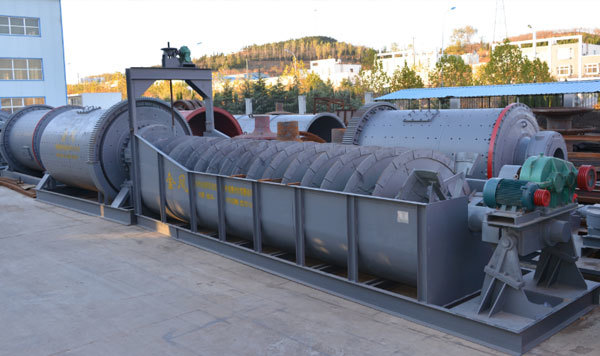
The spiral classifier is a commonly used mineral processing equipment. It mainly relies on the principle that solid particles with different specific gravities settle at different speeds in a liquid to perform mechanical classification. This equipment features a simple structure, reliable operation, and easy handling. It is generally paired with a ball mill to form a closed-loop circuit for classifying ore sand, graded ore sand, and fine mud, performing particle size classification and other tasks. During use, the classifier often encounters the following issues that affect production efficiency. Below is a brief introduction to common faults of the spiral classifier and their solutions:
1. Shaft breakage: This usually occurs due to fluctuating sand return volume, uneven load, poor shaft material, and processing quality; improper installation or shaft bending can also cause it. It can be resolved by welding or replacing the shaft. Causes of shaft breakage: 1) Insufficient strength: The hollow shaft of the classifier is generally made of thick-walled seamless steel pipe, while the existing shaft type is made by bending 20 steel plates into a semicircle and welding, resulting in insufficient strength; 2) Process reasons: High slurry concentration causes severe caking on the spiral blades of the classifier, the outlet screen plate gaps are too large, and broken balls, iron blocks, and debris enter the classifier trough causing jamming, which increases the operating load; 3) Operation and maintenance reasons: When the ball mill system stops, incomplete cleaning causes material caking, making the next operation difficult; increased equipment capacity and operating rate without timely adjustment of cleaning and maintenance work.
2. Idling of the lifting gear during descent: This is due to excessive sediment accumulation in the trough and can be resolved by digging out and removing the sediment.
3. Bending of spiral blades or spokes: This is caused by excessive sand return leading to blockage of the sand return trough or excessive sand return during startup; insufficient spiral lifting before starting. It can be resolved by repairing or replacing the spiral blades or spokes.
4. Flange or packing being too loose; a loose gasket allows sand to enter the lower shaft end, which can be fixed by repairing the lower shaft end.
Recommended


Contact Us
No. 599 Wenquan Road, Zhaoyuan City, Shandong Province
Official WeChat Public Account
Official Douyin Account
Online Message
Filling in your phone and email information will help us contact you promptly and resolve your issues as soon as possible.